Researcher
Active Quant: finding alpha with confidence
Blending data-driven insights, risk control and quant expertise to pursue reliable returns.






Value investing has a long tradition among equity and credit investors, and can be summed up as buying ‘cheap’ and selling ’expensive’. The exact approach differs across asset classes, but the goal is the same: to identify relative mispricings. Our research finds that ML-based risk controls further reduce risk, enhancing the stability of the ML-based value factor in the face of systematic shocks and underscoring its advantages over traditional credit methods.





In the equity market, a stock's valuation is often determined by comparing its market price to a fundamental anchor, such as the company's book value or earnings. Similarly, value investing in the credit market seeks to identify mispricings by determining whether a bond's credit spread adequately compensates for its risk.
A typical quantitative approach is to estimate the fair spread in a linear regression framework on credit spreads (Houweling and Van Zundert, 20171 ). The residual of the regression serves as a value measure, which is the difference between the estimated fair spread and the market spread. A large residual indicates that a bond is mispriced, while a small residual indicates that a bond is fairly priced.

Blending data-driven insights, risk control and quant expertise to pursue reliable returns.
However, linear regression models can’t handle more complex dependencies between risk measures (nonlinearities and interactions) easily, because the number of explanatory variables quickly becomes unmanageable. For example, five risk measures leads to ten interactions, but with ten risk measures, the number of interactions is already forty-five.
The idea is thus to use a model based on machine learning (ML), specifically so-called regression trees, to enhance the value factor. To better control for risk than traditional methods, regression trees can account for non-linearities and interaction effects, thereby reducing the bias toward riskier bonds and allowing investors to benefit more from true mispricings.
To see how successful the ML-based value factor is at reducing risk, we evaluate the exposures of the ML-based value factor to traditional corporate bond risks and compare it to a value factor with linear risk controls and a value factor with no controls.
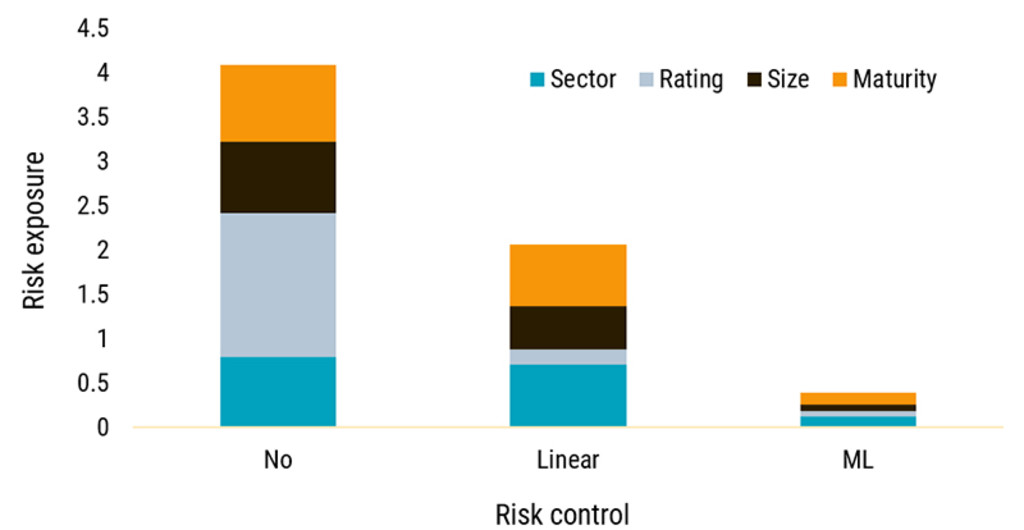
Source: Robeco, 2024.
For all value factors, we measure the exposure to credit ratings, sectors, issuer size groups, and maturity groups for each month and aggregate the active exposures over time. A lower risk exposure score indicates that a value factor is better at controlling a given risk dimension. The figure shows that using linear risk controls reduces the risk by half compared to having no controls at all, demonstrating the importance of controlling risk.
The figure also shows that using ML-based risk controls reduces risk even more. This significant reduction in risk makes the ML-based value factor less vulnerable to systematic shocks and therefore less risky, clearly demonstrating the advantages of an ML-based approach over traditional value factors in credit. This is one of the reasons why we also use an ML-based value factor in our Quant Credit products, such as Multi-Factor Credits and Multi-Factor High Yield.
Further information can be found either in our paper “True Value Investing in Credits through Machine Learning” or in an article on our website.
1Houweling, Patrick and Jeroen van Zundert. 2017. “Factor Investing in the Corporate Bond Market.” Financial Analysts Journal 73 (2): 100-115.
Subscribe to our newsletter for investment updates and expert analysis.
THIS WEBSITE IS SOLELY INTENDED FOR PROFESSIONAL INVESTORS, WHICH HAS THE MEANING ASCRIBED TO IT IN THE SECURITIES AND FUTURES ORDINANCE (CAP. 571 OF THE LAWS OF HONG KONG) AND ITS SUBSIDIARY LEGISLATION. Investment involves risks. Past performance is not indicative of future performance. The information contained in this website is provided for reference only and does not constitute investment advice or an offer or solicitation to buy or sell in any securities or to adopt any investment strategy. Investors should not base their investment decisions solely on the information provided on this website and are advised to seek independent advice (including advice on tax implications) before making any investment decisions. Investors should ensure they fully understand the risks associated with the investment products and should also consider their own investment objectives and risk tolerance level. The investment decision is yours. You should not invest unless the intermediary who sells you the investment products has advised you that it is suitable for you and has explained how it is consistent with your investment objectives. Please refer to the relevant offering documents or other legal documents for further details including the risk factors. This website is published by Robeco Hong Kong Limited which is regulated by the Hong Kong Securities and Futures Commission (“SFC”) (CE No. APU851). This website has not been reviewed by the SFC. No assurance can be given that the investment objective of any investment products will be achieved. No representation or promise as to the performance of any investment products or the return on an investment is made. The value of investments may fluctuate. Past performance, projections, or forecasts included in this website should not be regarded as guarantees or indications of future performance, and no express or implied warranty is provided. The contents of this website are based on sources believed to be reliable, but due to the nature of information delivery technology and the necessity of using multiple data sources, including third party content, their accuracy is not guaranteed. The opinions expressed are as of the date shown above and may change as market conditions evolve, and are subject to change without notice. These opinions may differ from those of other Robeco investment professionals. Robeco accepts no liability for any direct, indirect, or consequential loss arising from the use of this material or any comments, opinions, or estimates contained herein. Robeco has no duty to update this website or any website content. Materials on this website may not be reproduced, distributed, or published without prior written permission from Robeco. Unless otherwise specified, Source: Robeco.
Warning – Fraudulent use of Robeco on websites and social media Read more