
Portfolio Manager


• Insight
Investing in the circular economy
The boundless appetite for resources, fueled by linear production and consumption patterns, is exceeding the planet’s regenerative capacity. Regulatory actions for higher circularity are amplified by consumers opting for circular products. With ongoing innovations and technological advancements, prospects for de-materialization look better than ever. But how can investors navigate this transition to benefit from the emerging investment opportunities?
Authors


Sector Lead
Summary
- Today’s linear global economy uses resources at an average rate of 1.75 times higher than the Earth’s regenerative capacity.
- Innovations, consumer pressure, and regulatory actions promote higher circularity
- Our systematic framework identifies four key investment areas
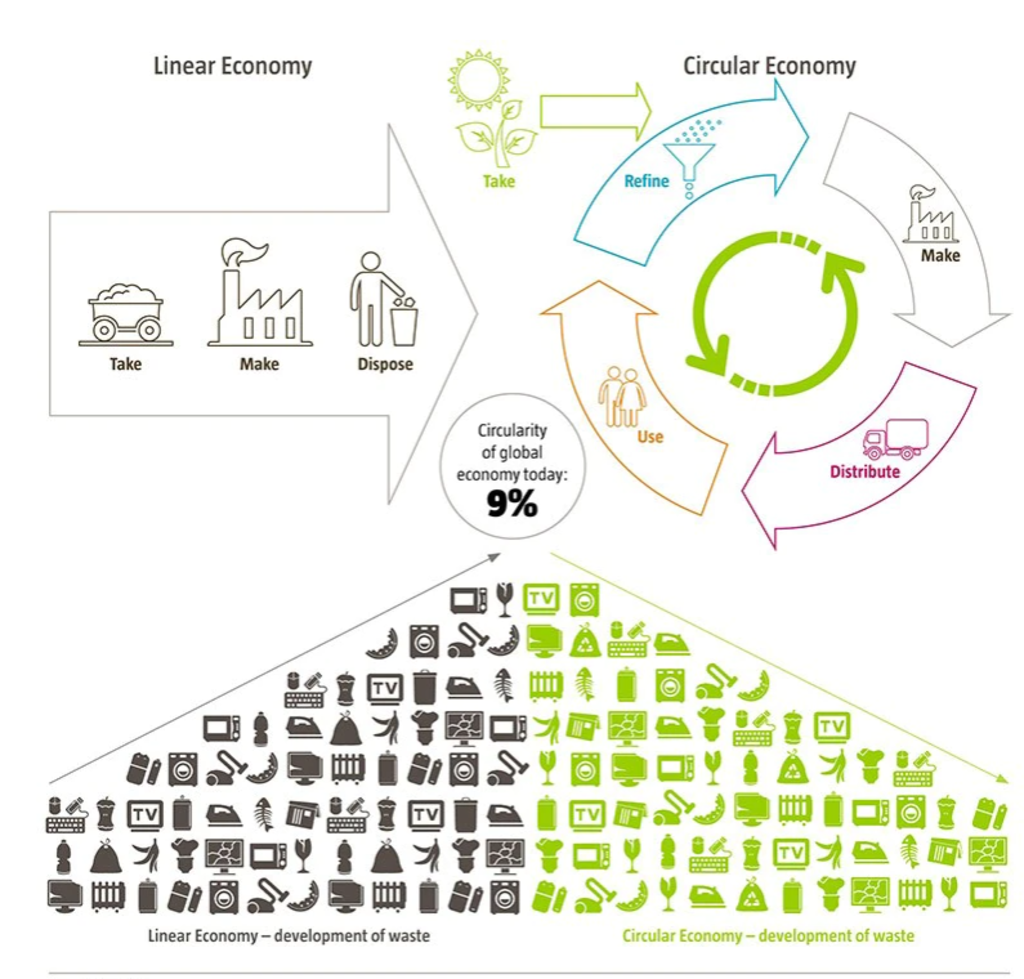
The traditional linear economy based on the “take-make-dispose” production and consumption model has pushed the planet’s capacity out of balance, and has led to a growing coalition of scientists, innovators, policy-makers, and consumers calling for a transition to closed-loop production and consumption systems that minimize waste and emissions as well as material and energy losses. The switch to the circular economy could unlock an estimated USD 4.5 trillion of value globally by 2030, with innovative technologies providing new ways to create service models and to extract value from closed-loop systems.
The switch to the circular economy could unlock an estimated USD 4.5 trillion of value globally by 2030
Source: Robeco
Technological drivers of the circular economy
Technology is becoming a key enabler of the transition to a circular economy. Advances in artificial intelligence (AI), digital platforms and cloud-based solutions have greatly eliminated the need for physical assets, helping to de-materialize entire value chains. The ongoing digital penetration of production and logistics improves the traceability of resource and product flows and can help optimize product use over their lifetime, including predictive maintenance solutions. Increased visibility enables not only better control over potential waste creation, but also creates more accountability for companies along the value chain. Meanwhile, the advancement of new chemicals and catalysts enables production of bio-based materials to replace fossil alternatives.

Circular economy
Investing in the circular economy
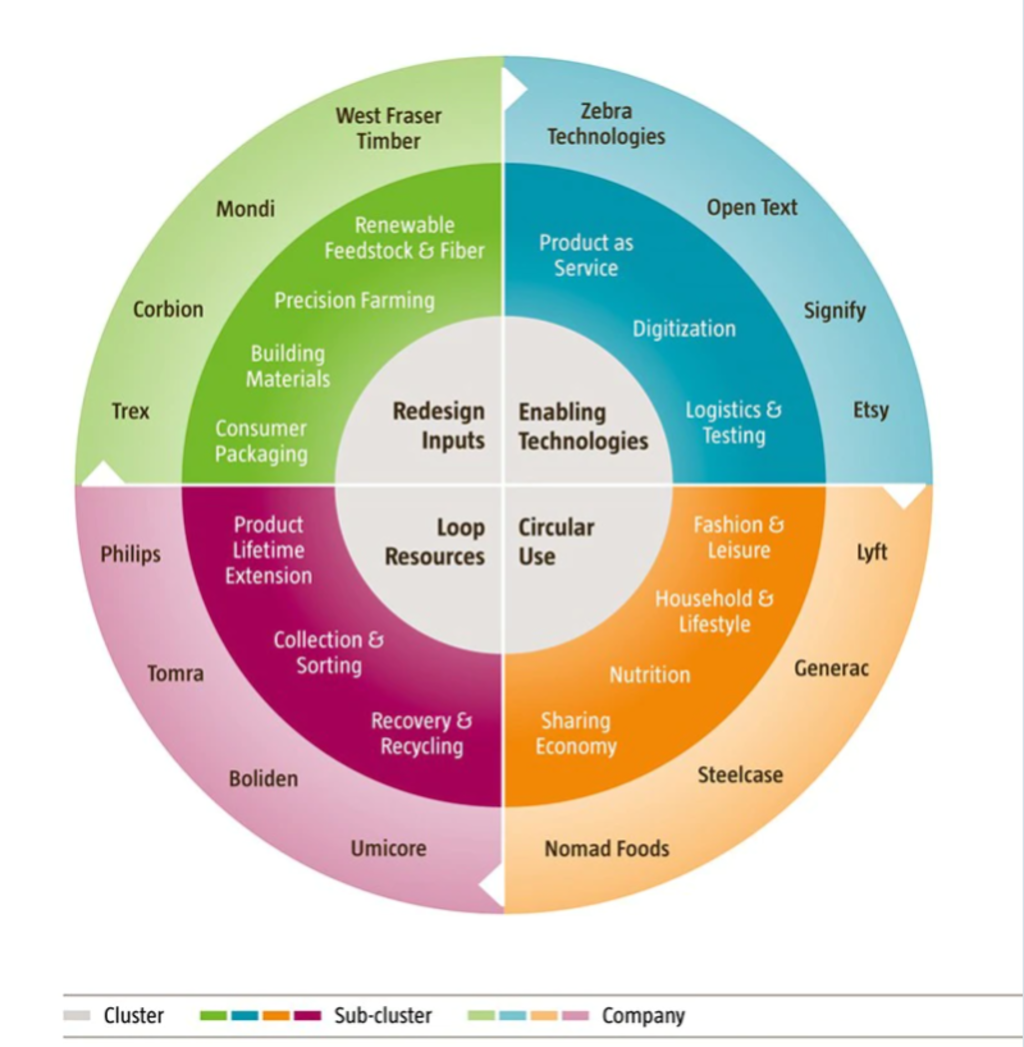
We have identified four investment clusters that are set to benefit from the transition to the circular economy: the redesign of production inputs, enabling technologies, circular use, and loop resources.
The first cluster – ‘redesign inputs’ – captures investment opportunities that exploit the shift from fossil-based inputs to renewable ones. The ‘enabling technologies’ cluster focuses on solutions that either provide the infrastructure for circular economy businesses, contribute to the de-materialization of production or create new, non-linear business models such as product-as-a-service. The ‘circular use’ cluster includes companies that support circular consumption patterns through sustainable sourcing, sharing economy, product longevity, and reusability. The ‘loop resources’ clusters focuses on providers of solutions that extend product lifecycles or recover embedded value from disposed products.
Source: Robeco
Conclusion
The time looks ripe for directing the global economy toward higher circularity. Governments are standing firm behind their commitments to the circular economy despite the economic challenges due to the ongoing pandemic. By exposing critical vulnerabilities in global supply chains, the current pandemic has even lent additional urgency to the shift from linear to system thinking, while providing a glimpse into the extensive de-materialization possibilities ahead, empowered by maturing digitization solutions across several sectors.
As innovative technologies are helping to unlock new value from the circular economy, the shift to higher circularity is becoming a matter of basic economics rather than a trend driven purely by environmental urgency. Companies pursuing circular business models are set to win from the structural changes ahead, with innovation leaders applying circular economy principles to differentiate their product offering. Forward-looking investors can benefit from this as yet largely untapped growth story by allocating capital to business models aligned with circular economy principles or to the enablers of this transition.
Download the publication
Important information
THIS WEBSITE IS SOLELY INTENDED FOR PROFESSIONAL INVESTORS, WHICH HAS THE MEANING ASCRIBED TO IT IN THE SECURITIES AND FUTURES ORDINANCE (CAP. 571 OF THE LAWS OF HONG KONG) AND ITS SUBSIDIARY LEGISLATION. Investment involves risks. Past performance is not indicative of future performance. The information contained in this website is provided for reference only and does not constitute investment advice or an offer or solicitation to buy or sell in any securities or to adopt any investment strategy. Investors should not base their investment decisions solely on the information provided on this website and are advised to seek independent advice (including advice on tax implications) before making any investment decisions. Investors should ensure they fully understand the risks associated with the investment products and should also consider their own investment objectives and risk tolerance level. The investment decision is yours. You should not invest unless the intermediary who sells you the investment products has advised you that it is suitable for you and has explained how it is consistent with your investment objectives. Please refer to the relevant offering documents or other legal documents for further details including the risk factors. This website is published by Robeco Hong Kong Limited which is regulated by the Hong Kong Securities and Futures Commission (“SFC”) (CE No. APU851). This website has not been reviewed by the SFC. No assurance can be given that the investment objective of any investment products will be achieved. No representation or promise as to the performance of any investment products or the return on an investment is made. The value of investments may fluctuate. Past performance, projections, or forecasts included in this website should not be regarded as guarantees or indications of future performance, and no express or implied warranty is provided. The contents of this website are based on sources believed to be reliable, but due to the nature of information delivery technology and the necessity of using multiple data sources, including third party content, their accuracy is not guaranteed. The opinions expressed are as of the date shown above and may change as market conditions evolve, and are subject to change without notice. These opinions may differ from those of other Robeco investment professionals. Robeco accepts no liability for any direct, indirect, or consequential loss arising from the use of this material or any comments, opinions, or estimates contained herein. Robeco has no duty to update this website or any website content. Materials on this website may not be reproduced, distributed, or published without prior written permission from Robeco. Unless otherwise specified, Source: Robeco.