

Head of Next Gen Research


• Insight
AI in investment research: from faster summaries to stronger insights
Agentic AI in asset management | Research
Agentic AI could reshape investment research: not by replacing researchers, but by changing how ideas are found, tested, documented and challenged. Agentic AI does not replace research judgment; it gives researchers a stronger research engine.
Authors

Investment research has always been a race against complexity. Markets generate more data, more papers, more company information, more news, more alternative datasets and more competing narratives than any single team can process manually. The challenge today is not simply finding information, but determining what matters, how reliable it is, whether it adds anything new, and whether it can be translated into a research question or investment insight.
This is where agentic AI may begin to change the research process. The first wave of generative AI helped individuals work faster: summarizing documents, drafting text, writing code and answering questions. Useful, but still largely task-based. Agentic AI goes further, by supporting multi-step workflows, carrying context from one step to the next, using tools, monitoring tasks and producing structured outputs that can be reviewed by humans.
Figure 1 below outlines what the agentic research desk could look like today – or might look like in the near future.
Figure 1 | Four possible building blocks of agentic AI in investment research
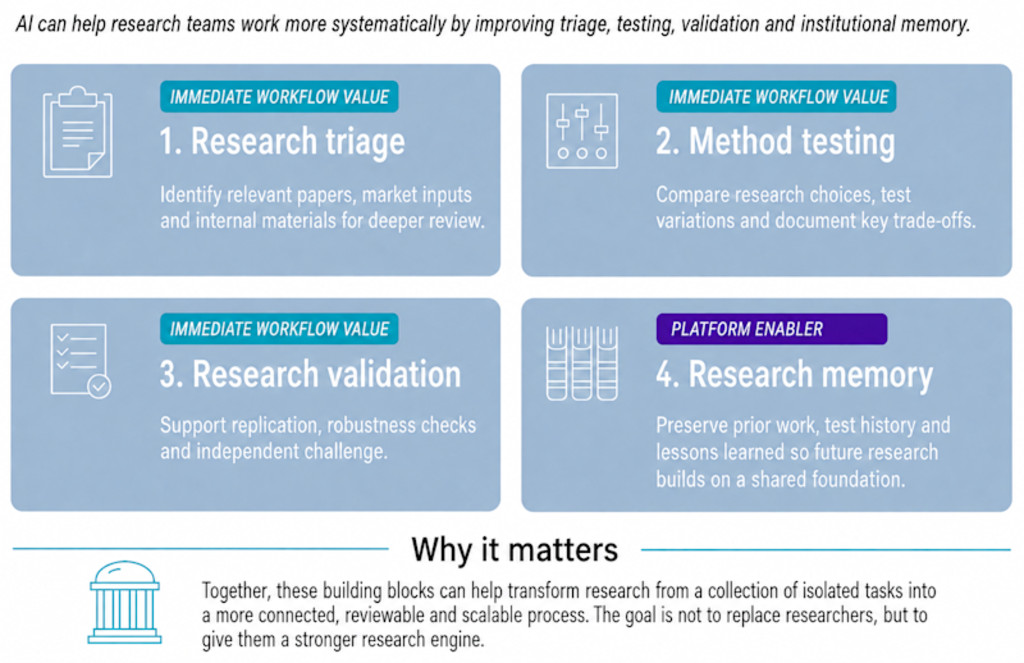
Source: Robeco, August 2026.
In investment research, this shift is important because research is a chain of work: sourcing ideas, gathering evidence, testing assumptions, comparing signals, documenting findings, challenging conclusions, and deciding whether an idea is worth escalating. But rather than automating judgment, the goal when it comes to agentic AI is to give researchers a better research engine.
From information overload to research triage
A practical starting point is research triage. Investment teams face a constant flow of academic papers, market commentary, earnings transcripts, filings, internal notes and client questions. Much of investing still begins with this kind of narrative: news flow, policy shifts, analyst debate, management commentary and changing market sentiment.
Much of it may be relevant; most of it cannot be read in full. A human analyst’s time is limited, and these inputs have traditionally been difficult to use systematically because they are qualitative, contextual, and often messy.
An agentic research workflow can help separate signals from noise at the earliest stage: scanning large volumes of material, identifying what may deserve deeper review, extracting key claims and flagging where a new idea overlaps with existing research. A paper-scanning agent, for example, does not decide whether an idea belongs in a portfolio. It helps researchers decide where to spend their attention.
From information overload to research triage
In this way, interpretation can become more scalable and more disciplined. A researcher still decides whether a narrative is economically meaningful, whether it is already reflected in prices, and whether it adds anything new. But AI can help surface patterns across companies or sectors and make it easier to test whether a narrative has signal value.
For investors seeking to combine fundamental insight with systematic discipline, often described as a quantamental approach, this is especially relevant. The opportunity is not to choose between human judgment and systematic analysis, but to connect them more effectively: using AI to process narrative information at scale while keeping human researchers responsible for the questions, the interpretation and the decision to test further.
From signal discovery to research memory
Once narrative information has been structured, the next challenge is research discipline. AI can help screen candidate ideas, extract methodologies, map required data inputs and support replication work. It can also help compare design choices and document the trade-offs behind them.
That breadth creates a risk: AI can widen the search not only for promising ideas, but also for false positives. A plausible result can look convincing before it has been tested deeply enough. The value of an agentic workflow is therefore to make the path from idea to evidence more systematic and easier to challenge, by recording what was tested, why it was tested, which assumptions mattered, where results were fragile, and why a line of research was escalated, paused or rejected.
In that sense, agentic AI can strengthen research memory. Failed tests are not wasted if they are properly recorded. They become part of the firm’s institutional knowledge, helping future researchers avoid rediscovering the same non-result in a slightly different form.
From research notes to evidence trails
A major opportunity lies in documentation. Investment research often depends on people remembering why a decision was made: which dataset was used, which assumptions were rejected, why a particular signal was not adopted, or why a model was changed.
Agentic workflows can help by creating an evidence trail around AI-supported research. That trail might include the source documents used, access timestamps, model or workflow version, tool calls, analyst edits, stability checks, validation results and the named human reviewer. Rather than simply being bureaucracy, this makes AI-supported research reviewable.
A polished AI-generated memo can be dangerous if no one can tell what the model produced, what the analyst changed, which claims were sourced and which conclusions were challenged. The more AI is used to prepare research, the more important it becomes to separate raw model output from firm-approved investment work.
Ultimately, the research desk of the future may be more documented, not less. More systematic, not less. More transparent about uncertainty, not more confident by default.

AI investing: Back to school
Agentic AI in asset management
Asset managers are moving beyond generative AI tools toward agentic AI systems that can support workflows, monitor tasks and assist with defined actions.
What changes for researchers?
If AI can gather information, summarize papers, draft code and test variations faster, the human researcher spends less time assembling evidence and more time judging it. That requires different skills: asking better questions, recognizing weak evidence, understanding data lineage, challenging model outputs, spotting implementation problems and knowing when not to escalate an idea.
For younger researchers in particular, this might be especially important. AI can certainly flatten parts of the learning curve by making information easier to access. But it can also create a false sense of mastery. Reading a summary is not the same as understanding a method. Replicating a result is not the same as knowing whether it belongs in a live strategy. In the age of agentic AI, research culture is as central as ever, because it can scale both good habits and bad ones.
What remains human?
Humans decide whether the question is worth asking. Humans decide whether the result makes economic sense. Humans decide whether an idea is strong enough to be tested further, escalated or set aside. Humans decide whether the evidence is strong enough to enter an investment process. The value of agentic AI in research may therefore be less about replacing expertise and more about connecting different forms of expertise: fundamental context, systematic testing, data discipline and human judgment.