

Chief Researcher


• Insight
Rethinking US exceptionalism: A case for diversification
For years, one dominant theme has been rewarded: back the US, and tune out the rest. For some investors, that positioning was not even a deliberate choice. It crept in gradually, driven by relative returns, benchmark evolution and the quiet compounding effect of flows toward whatever was working. Today, that assumption deserves a closer look.
Authors






Strategist
Summary
- US exceptionalism is no longer a given
- Broad, attractively valued opportunity set is hiding in plain sight
- Combining diversification with alpha generation can aid portfolio resilience
This is not a case against the US, which remains the world’s deepest capital market, the anchor of global liquidity and a genuine leader in innovation. But it is a case for asking a more nuanced question: is the persistence of US exceptionalism still something investors can rely on?
Markets are often interpreted through a cyclical lens: inflation, rates, growth. But today’s shift looks less like a normal cyclical turn and more like a structural transition. For decades, global markets operated around one reserve currency, one primary innovation hub and one main destination for global capital. The US occupied that role exceptionally well. That system is not collapsing, but it is evolving.
The objective is not to reduce US exposure. It is to reduce reliance on a single source of returns
Economic activity, innovation capacity and human capital are gradually dispersing across geographies. Capital flows are adjusting at the margin. At the same time, US-specific risks around trade policy, fiscal sustainability and geopolitical posture have re-entered the conversation in a way they largely had not for years. For much of the past 15 years, political and macro risk were associated mainly with Europe and emerging markets. Increasingly, that assumption is being tested.
Non-US assets may only need a less dominant US
This does not mean the US needs to weaken structurally for non-US assets to perform better. They may only need a less dominant US. Real disposable income growth has slowed in a sticky inflation environment, while elevated fiscal deficits, a rising Treasury interest burden and historically high US profit margins imply a less forgiving backdrop for valuations.
The risk of narrow leadership
Another defining feature of recent years has been how narrow equity market leadership has become. A small group of US mega-cap companies, concentrated largely in technology and AI, has driven a disproportionate share of global returns. Strong earnings, rising valuations and index reweighting created a self-reinforcing cycle: performance attracted flows, flows supported market caps, and rising market caps increased concentration.
On closer inspection, then, US exceptionalism has increasingly become narrow exceptionalism. That matters because portfolios built around this concentration may be more fragile than they appear. History is consistent on one point: equity leadership rotates.
The opportunity hiding in plain sight
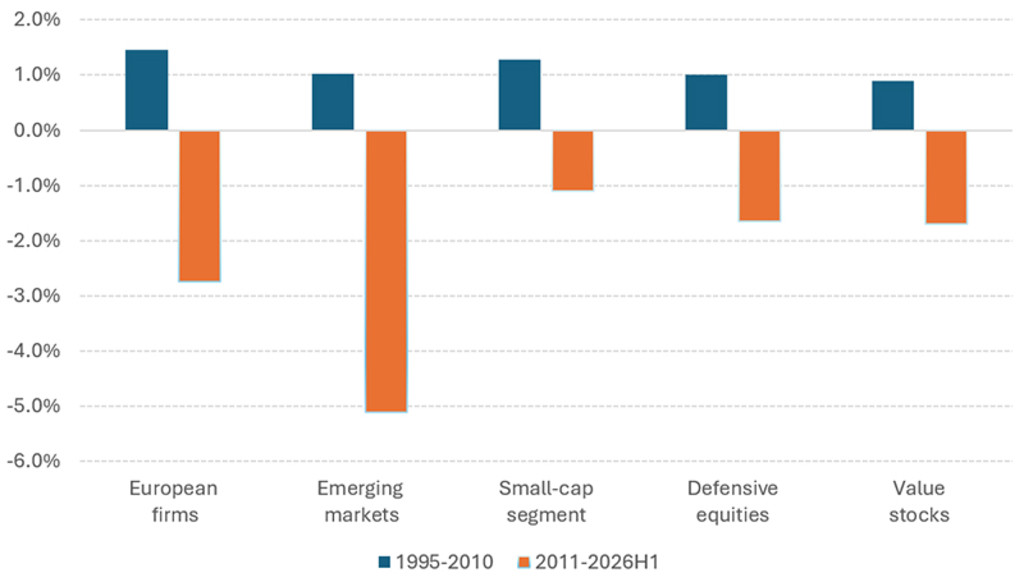
Beyond US large-cap growth lies a wide set of equity segments that have been overlooked, and in some cases actively avoided, for much of the past 15 years. These include European equities, emerging markets, small caps, defensive equities and value stocks. Each has materially underperformed global markets over the recent period. But that underperformance is precisely why allocations have declined, and why the opportunity may now be hiding in plain sight.
A longer history shows a different picture. In the 16 years before the recent US-led stretch, these segments generated significant outperformance, not simultaneously, but at different times and in different market environments.
Figure 1 – Relative performance versus MSCI ACWI, from January 1995 to June 2026
Past performance is no guarantee of future results. The value of your investments may fluctuate.
Source: LSEG, MSCI, Robeco. For the global market we use the MSCI All Country World Investable Market Index (ACWI IMI), while for the contrarian alternatives we consider the MSCI Europe Index for European firms, MSCI Emerging Markets Index for emerging markets, MSCI All Country Small Cap Index for the small-cap segment, MSCI World Minimum Volatility Index for defensive equities, and MSCI All Country World Investable Value Index for value stocks. Data is available from January 1995 to June 2026. All returns are based on total returns and denominated in US dollars.
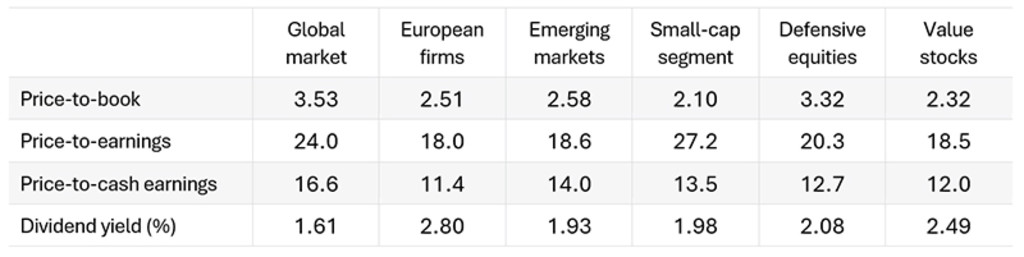
Today, they also share another feature: each trades at a meaningful valuation discount to the broader market across measures such as price-to-book, price-to-earnings, price-to-cash earnings and dividend yield.
Table 1 – Valuations as at 30 June 2026
Past performance is no guarantee of future results. The value of your investments may fluctuate.
Source: LSEG, MSCI, Robeco. For the global market we use the MSCI All Country World Investable Market Index (ACWI IMI), while for the contrarian alternatives we consider the MSCI Europe Index for European firms, MSCI Emerging Markets Index for emerging markets, MSCI All Country Small Cap Index for the small-cap segment, MSCI World Minimum Volatility Index for defensive equities, and MSCI All Country World Investable Value Index for value stocks. Data is available from January 1995 to June 2026.
Five segments, five different return drivers
Crucially, this is not a single trade or one unified macro bet. Recent performance illustrates the point: emerging markets have delivered strong returns, while several of the other segments have not, showing that they do not move together or depend on the same conditions. Europe, emerging markets, small caps, defensive equities and value stocks each have different return drivers:
Europe may benefit from fiscal-driven recovery and risk-premium compression.
Emerging markets may benefit from global manufacturing strength and weaker-dollar tailwinds.
Small caps tend to respond to falling financing costs and domestic demand.
Defensive equities can provide resilience in risk-off environments.
Value stocks may benefit when higher rates put pressure on growth-stock multiples.
That is the essence of diversification. The question is not which segment will outperform next. In practice, that is extremely difficult to forecast. The point is that different market regimes reward different parts of the market, and the timing of those transitions is inherently uncertain. The real risk is being unexposed when leadership changes.
3D EM Equity UCITS ETF USD Acc
- performance ytd (30-9)
- 30.24%
- SFDR (30-9)
- Article 8
- Dividend Paying (30-9)
- No
- Current Price (16-10)
- 8.67
- Inception date (30-9)
Past performance is no guarantee of future results. The value of the investments may fluctuate. Annualized (for periods longer than one year). Performances are net of fees and based on transaction prices.
Diversification needs discipline
Diversification alone, however, is necessary but not sufficient. It expands the opportunity set, but it does not guarantee better outcomes. Implementation matters. In uncertain environments, investors often become pro-cyclical: chasing recent winners, exiting underperformers and rotating too late. The segments that offer the greatest diversification benefit are often the hardest to hold through periods of underperformance.
This is where quantitative investing can help. A disciplined, rules-based process can reduce the behavioral biases that undermine long-term returns. Rather than relying on market timing or short-term conviction, a systematic approach applies the same investment discipline across regions, styles and market segments. It helps investors stay exposed to a broader opportunity set, even when recent performance makes that uncomfortable.
Robeco’s quant approach is built around decades of research into empirically proven return drivers, such as value, quality, momentum, analyst revisions and short-term signals. These factors have been enhanced over time and are combined within a consistent portfolio construction framework that seeks to balance return potential, risk control and diversification.
Robeco’s range of quantitative strategies
Enhanced indexing strategies are designed as smart alternatives to passive, seeking consistent excess returns while staying relatively close to the benchmark. Active quant strategies target higher alpha within a controlled risk framework, making them suitable for investors looking to augment portfolio returns. Defensive, or conservative, strategies focus on lower-risk equity exposure and aim to improve the return path by reducing drawdowns. Value strategies provide more targeted access to a specific long-term return premium, while next-gen small-cap strategies use advanced data, refined signals and machine learning techniques to capture alpha in a broad, less efficiently researched part of the market.
Building portfolios for a less certain world
If markets are transitioning from a concentrated regime toward a more dispersed one, portfolios need to reflect that shift. The objective is not to reduce US exposure. It is to reduce reliance on a single source of returns. In a world where exceptionalism is no longer a given, resilience becomes the defining edge. And resilience is built not by predicting where leadership will emerge next, but by diversifying thoughtfully and implementing with discipline.

Investing beyond the US
Opportunities in global equities, emerging markets and Europe