

Portfolio Manager


• Insight
Reduce, recycle, reshore: localization is revving up the circular revolution
While reshoring doesn’t feature among the circular economy’s traditional refrain of ‘reduce, reuse, recycle’, it does act as a catalyst to promote a host of circular solutions. With a strong focus on IT, AI and industrials as well as domestic suppliers, the circular economy strategy is well positioned to capture the short and long-term growth of reshoring waves.
Authors

Summary
- Reshoring is gaining momentum amid high tensions and tariffs
- Reshoring promotes circularity, circularity facilitates reshoring
- Reshoring tailwinds strongest for Industrials, IT and local manufacturers
The Covid pandemic, escalating conflicts, and rising trade tensions have all exposed the vulnerabilities of offshore production and supply chains. Already in 2021, business executives cited cyberattacks, commodity price fluctuations, diverging regulations, and China’s slowdown behind the Covid pandemic as significantly disruptive supply chain events. Threats once thought to be temporary have materialized into structurally persistent costs of globalization. Spring forward to 2023 and mentions of “reshoring” in earnings calls of S&P 500 companies were up 128% compared to a year earlier. More impressively, US manufacturing construction is booming (see Figure 1). Likewise, 78% of EU business executives from diverse sectors planned on moving parts of their supply chains back home, according to a UBS survey. 1
Figure 1 – A boom in spending in US manufacturing construction
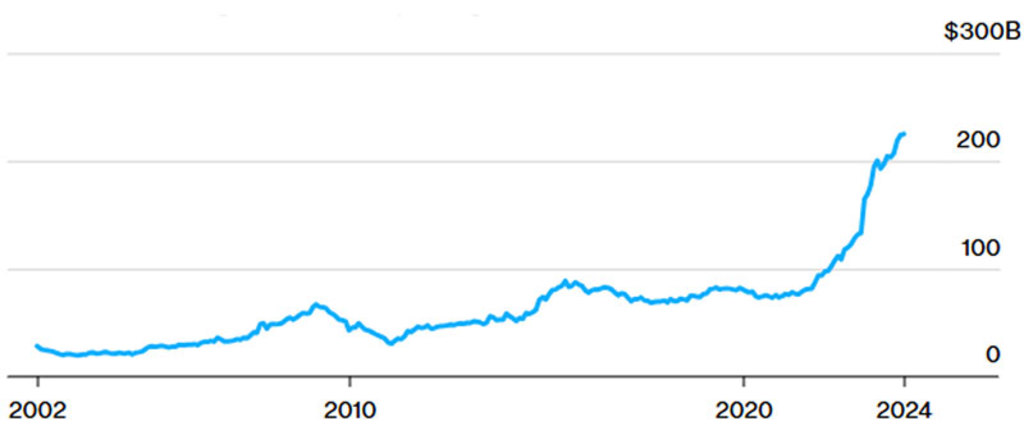
Source: US Census Bureau, Bloomberg, March 2024. US Manufacturing Boom is about more than EVs and chips.
Reshoring promotes circular solutions
Reshoring reduces supply chain length and complexity. This not only improves resilience and reliability, it also reduce emissions and waste associated with long-haul transport. Furthermore, reshoring adds visibility and control enable companies to invest in circular solutions, especially those enhanced with AI technologies.
Industrial engineers and project developers are adopting AI powered circular solutions to avoid bottlenecks, minimize material use, reduce waste. This reduces costs and accelerates reshoring construction efforts. Once operational, companies can deploy more AI-enhanced solutions that conserve resources and improve margins while reducing waste and pollution. Using AI models, companies are better able to predict domestic demand, adjust inventories, and accelerate material sourcing while at the same time reducing operational inefficiencies, product waste and short-haul emissions.
Reshoring also comes with downsides, especially for EU and US markets. Robust regulatory systems, skilled labor shortages and limited access to critical raw materials all make reshoring more costly for EU and US companies. The upside to these challenges is that they are also forcing companies to embrace circular economy principles that reduce wasteful inefficiencies, improve material recovery and enhance labor productivity.
Circular solutions reduce costs of reshoring
Domestically based predictive maintenance and repair operation (MRO) networks are also driving down inflationary costs. Not only do MROs reduce costly equipment breakdowns and short-term operational expenses, they also keep machinery optimally running over longer lifetimes, reducing companies’ long-term capital expenses. Moreover, AI is significantly mitigating wage inflation and labor shortages. By leveraging automation and robotics, companies can streamline processes and reduce reliance on manual labor.
Figure 2 – Robotics is growing alongside reshoring
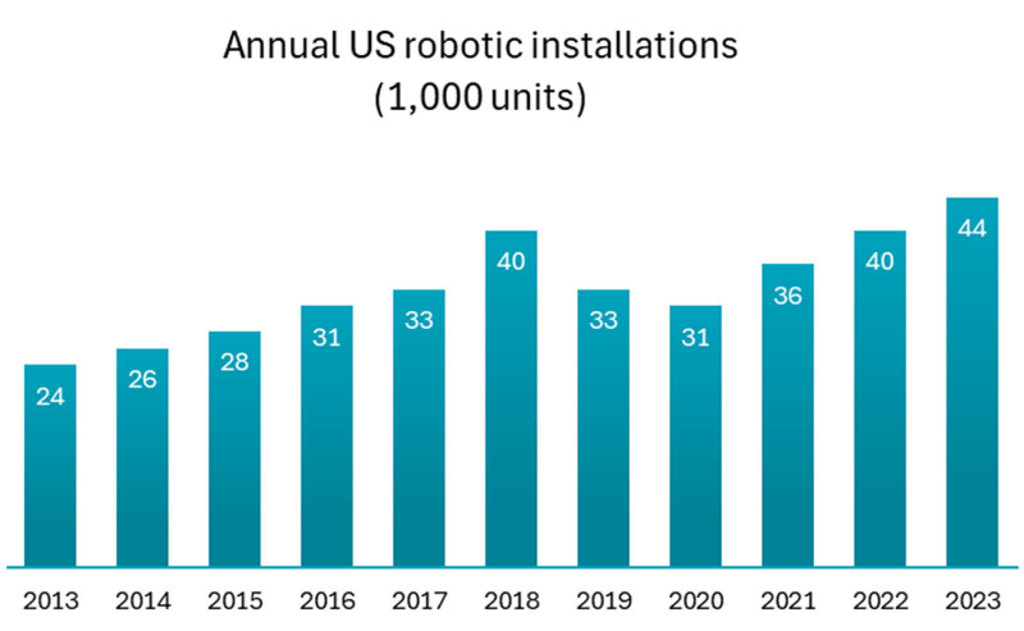
In the US, industrial robotic installations are growing. Source: U.S. Companies Invest Heavily in Robots - IFR Preliminary Results - International Federation of Robotics. April 2024.
Closer proximity to local markets means companies can adapt more quickly and efficiently to local regulations, such as the US IRA’s domestic procurement requirements or the EU’s recycled content mandates. AI-powered robotics are also aiding and abetting these efforts. Computer vision and machine learning are enabling the efficient recovery and recycling of valuable materials in product waste streams. Predictive analytics is also being used to evaluate suppliers based on important factors such as costs, location, quality, customization, emissions, and other sustainability.

Celebrating five years of investing for healthy returns and a healthy planet
Reshoring good for domestic growth
Reshoring encourages manufacturers to procure materials from domestic sources rather than imports. Moreover, reshoring contributes to increased investment in infrastructure. As companies build new factories and expand existing ones, there is a corresponding multiplier effect across a wide range of industries, from steel and cement to logistics and transportation.2 Bank of America research estimates that for every USD 10 billion of manufacturing revenue that is moved back to the U.S., there is around USD 3.8 billion of capex spending.3 In addition, according to one study, 7.4 new jobs are created in other industries for every durable manufacturing job generated by a reshoring project.4
Riding the waves to reshore
Circular solutions are well positioned to benefit from tailwinds created by the reshoring renaissance. The strategy has a mid-cap tilt, which benefit disproportionately from robust local demand and strong domestic growth relative to international conglomerates.
Industrials and technology companies that provide robotics and automation are set to be the biggest beneficiaries from government efforts to reshore manufacturing in strategic technologies such as chips, EVs and electric grid infrastructure.5 But growth is also spreading beyond artificial arms and neural networks to higher-value products that require more sophisticated manufacturing including high-end appliances, chemicals, medical supplies, logistics and transportation.6 Not only is the strategy rife with to these diversified areas, but it is also diversified by size, given many of its holdings in there companies are smaller large caps as well as mid- and small caps.
Regardless of size, lower interest rates will enable manufacturers to finance large investments into tech and automation to further boost productivity, growth and expansion.
Figure 3 – Strong sector and market cap diversification
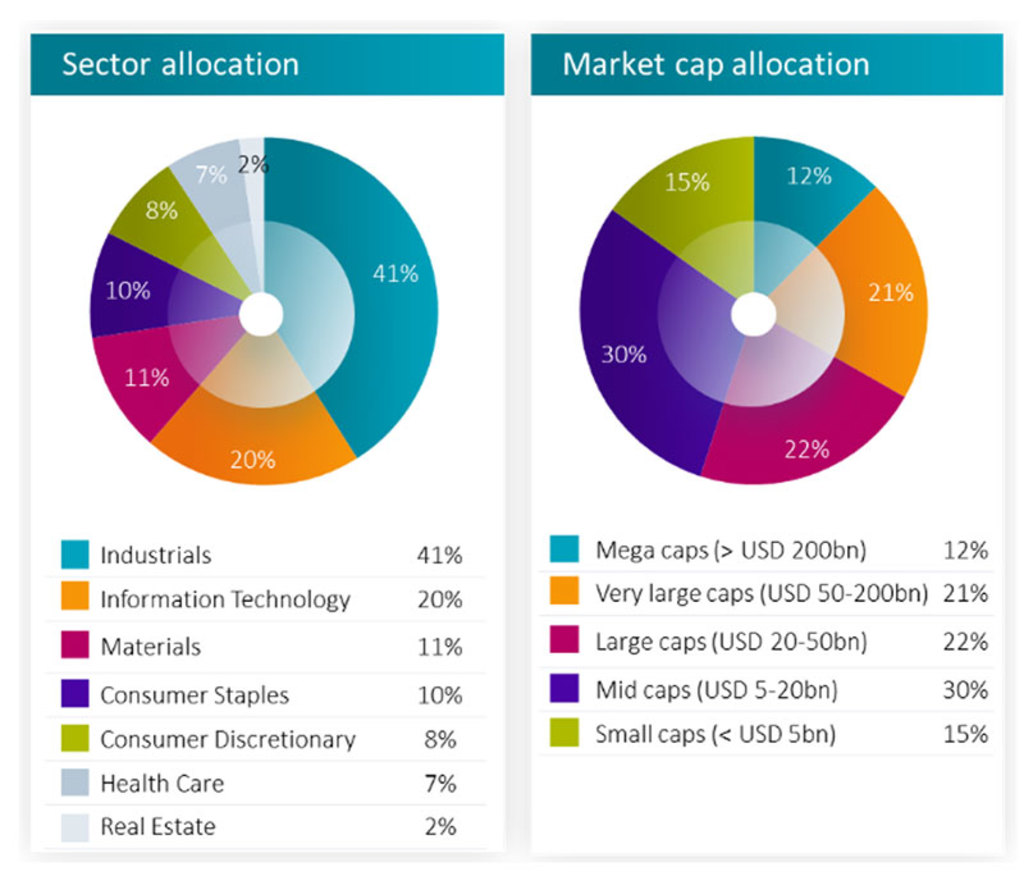
Source: Robeco. This is the current overview as of 31.12.2024 and not a guarantee of future developments. It should not be assumed that any investments in sector or market cap identified were or will be profitable.
Conclusion
Reshoring is set to flourish driven by supply chain disruptions, tightening tariffs, and incentive-heavy industrial policies. However, labor, regulatory and resource constraints raise the cost of doing business in the EU and US. That makes circular solutions an increasingly valuable commercial proposition for local businesses and global companies that reshore or invest in these markets.
The circular economy strategy is well-positioned to capture short and long-term growth from these important structural trends. Strong exposure to AI, automation, and smart manufacturing means the strategy will benefit from their positive impact on resource efficiency, productivity, and profitability. Moreover, exposure is balanced across large, small and midcap stocks. These companies can invest more intensively in circular innovation as well as benefit disproportionately from domestic incentives compared to international firms.
Longer term, by forcing companies to confront resource efficiency alongside productivity and profitability, reshoring trends are helping unlock sustainable production models and revving up the circular revolution.
Footnotes
1 CNBC, June 2023. Reshoring more domestic manufacturing due to supply chain disruption. June 2023.
2 https://manufacturing-today.com/news/why-the-reshoring-renaissance-is-the-future-of-u-s-manufacturing/
3 Bank of America. October 2024. “Regional Morsel: Reshoring grows roots in the South and Midwest.”
4 American Century Investments, 2024. Economic Policy Institute, 2019. “Reshoring reaches mid-America.”
5 Wall Street Journal. January 2024. Midcap stocks are often ignored. They shouldn’t be.
6 MIT, Sloan Management Review. November 2023. A Reshoring Renaissance Is Underway.
Get the latest insights
Subscribe to our newsletter for investment updates and expert analysis.
Important information
THIS WEBSITE IS SOLELY INTENDED FOR PROFESSIONAL INVESTORS, WHICH HAS THE MEANING ASCRIBED TO IT IN THE SECURITIES AND FUTURES ORDINANCE (CAP. 571 OF THE LAWS OF HONG KONG) AND ITS SUBSIDIARY LEGISLATION. Investment involves risks. Past performance is not indicative of future performance. The information contained in this website is provided for reference only and does not constitute investment advice or an offer or solicitation to buy or sell in any securities or to adopt any investment strategy. Investors should not base their investment decisions solely on the information provided on this website and are advised to seek independent advice (including advice on tax implications) before making any investment decisions. Investors should ensure they fully understand the risks associated with the investment products and should also consider their own investment objectives and risk tolerance level. The investment decision is yours. You should not invest unless the intermediary who sells you the investment products has advised you that it is suitable for you and has explained how it is consistent with your investment objectives. Please refer to the relevant offering documents or other legal documents for further details including the risk factors. This website is published by Robeco Hong Kong Limited which is regulated by the Hong Kong Securities and Futures Commission (“SFC”) (CE No. APU851). This website has not been reviewed by the SFC. No assurance can be given that the investment objective of any investment products will be achieved. No representation or promise as to the performance of any investment products or the return on an investment is made. The value of investments may fluctuate. Past performance, projections, or forecasts included in this website should not be regarded as guarantees or indications of future performance, and no express or implied warranty is provided. The contents of this website are based on sources believed to be reliable, but due to the nature of information delivery technology and the necessity of using multiple data sources, including third party content, their accuracy is not guaranteed. The opinions expressed are as of the date shown above and may change as market conditions evolve, and are subject to change without notice. These opinions may differ from those of other Robeco investment professionals. Robeco accepts no liability for any direct, indirect, or consequential loss arising from the use of this material or any comments, opinions, or estimates contained herein. Robeco has no duty to update this website or any website content. Materials on this website may not be reproduced, distributed, or published without prior written permission from Robeco. Unless otherwise specified, Source: Robeco.