Head of SI Thought Leadership and Climate & Biodiversity Strategist


• Climate Survey
Survey shows biodiversity rises in importance for investors
More than half of investors plan to make biodiversity a significant part of their investment policy, Robeco’s Global Climate Survey has revealed.
Authors

Summary
- 56% of investors will make biodiversity a core strategy in the next two years
- 79% complain of low awareness of the financial implications of biodiversity loss
- Large interest in investments that can help as their impact can be assessed
However, almost four in five respondents said there was a general lack of awareness of the financial implications of biodiversity loss, which is making it difficult to implement clear nature-friendly investment policies.
And almost three in four said investors do not have a way to assess the impact of investment decisions on biodiversity, led by a lack of data that also bedevils other attempts to pursue sustainable investing strategies such as net zero emissions.
These were key findings of the 2022 survey, the second of its kind to ask 300 investors with a combined USD 23.7 trillion in assets under management for their views on everything from climate change and engagement, to attitudes to the SDGs. This year a special section was included to garner opinions about biodiversity.
In January, Robeco published a white paper outlining its approach to biodiversity from all angles, and began a partnership with the World Wide Fund for Nature Netherlands to assist with its further integration into the investment process.
Perhaps the greatest revelation was the number of investors who now treat biodiversity seriously. Although crucial to maintaining the ecosystems on which all economic activity depends, biodiversity in the past has been seen as either a minor issue, or something that investors thought difficult to approach from a financial perspective.
Some 56% of investors said biodiversity will be at the center of, or a significant factor in, their investment policy in the next two years, while 41% have it playing a major role today. Regarding their motivation, 65% of wholesale investors and 52% of all those polled said they wanted to reduce long-term systemic risks associated with biodiversity loss, such as wide-scale deforestation and overly exploited ocean life.
The main findings of the biodiversity questions in the survey
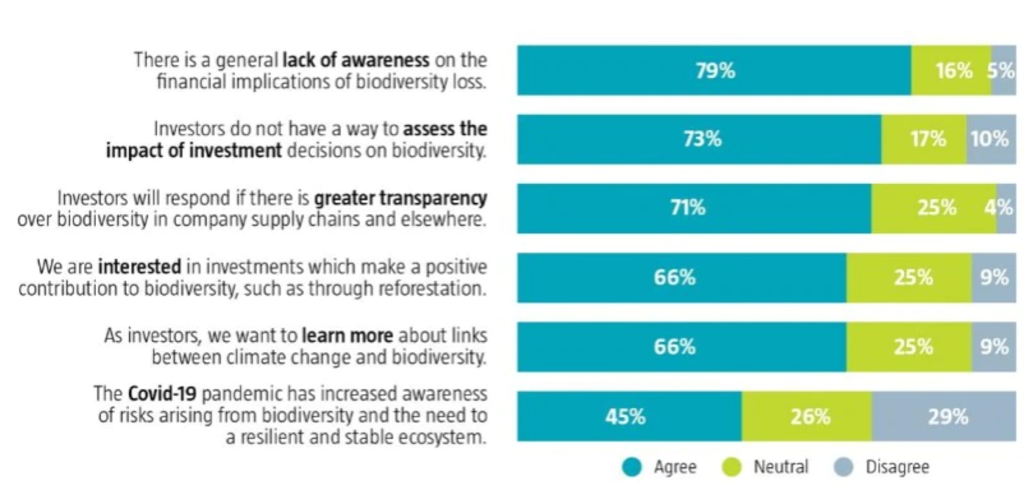
Source: Robeco, CoreData
What to invest in
So, what to invest in? Some 63% said food security and nutrition were good options, while 62% went for sustainable agribusiness. And 40% wanted to see more thematic investing offerings related to biodiversity – Robeco is working to launch such as strategy later this year.
Aside from direct investment, engaging with companies was seen as being important by 46% of those surveyed, while 37% said investors should work more with environmental organizations (such as the WWF-NL) to make an impact. Some 34% said exclusions or divestments should be used more often for the worst offenders on biodiversity.
Problems remain
However, keenness to get involved is not matched by the ability to do so. Some 79% said there is a general lack of awareness on the financial implications of biodiversity loss, partly due to difficulties in quantifying it on the bottom line. Some 73% said they do not have a way to assess the impact of investment decisions on biodiversity, and 50% cited a lack of data, reporting and ratings on biodiversity as an obstacle to taking account of it in investment portfolios.
Support for biodiversity investments is also not as high as it is for climate change. Only 36% said they had seen demand for it from their own stakeholders, while the same figure said they believed biodiversity was the next major trend. For climate change, a clear majority said both were relevant.
Global Climate Investing Survey 2022: Engagement and biodiversity
‘The next big thing’
“Biodiversity is often referred to as ‘the next big thing’, and this is reflected in the findings of our survey,” says Lucian Peppelenbos, Climate Strategist at Robeco. “A majority of investors are prioritizing biodiversity: they understand well how the global economy and financial markets are embedded in and dependent on the biosphere.”
“But they are struggling to make it concrete and operational in their portfolios. Because how does one link these impacts to individual issuers, and how do you aggregate this in portfolios? That’s the ‘million dollar question’.”
Building knowledge
“At Robeco, we recognized this challenge and initiated our biodiversity roadmap two years ago. In the first instance, our focus was on building knowledge and understanding the data, through partnerships such as with the University of Cambridge and more recently with the World Wide Fund for Nature Netherlands. Currently we are trialling data sources, building biodiversity investment strategies and developing an overall framework to address biodiversity across our portfolios.”
“Building on the momentum in the industry, we hope to come to tangible results in 2022 so that we can make a real difference for biodiversity through our investments.”
Keep up with the latest sustainable insights
Join our newsletter to explore the trends shaping SI.
Important information
THIS WEBSITE IS SOLELY INTENDED FOR PROFESSIONAL INVESTORS, WHICH HAS THE MEANING ASCRIBED TO IT IN THE SECURITIES AND FUTURES ORDINANCE (CAP. 571 OF THE LAWS OF HONG KONG) AND ITS SUBSIDIARY LEGISLATION. Investment involves risks. Past performance is not indicative of future performance. The information contained in this website is provided for reference only and does not constitute investment advice or an offer or solicitation to buy or sell in any securities or to adopt any investment strategy. Investors should not base their investment decisions solely on the information provided on this website and are advised to seek independent advice (including advice on tax implications) before making any investment decisions. Investors should ensure they fully understand the risks associated with the investment products and should also consider their own investment objectives and risk tolerance level. The investment decision is yours. You should not invest unless the intermediary who sells you the investment products has advised you that it is suitable for you and has explained how it is consistent with your investment objectives. Please refer to the relevant offering documents or other legal documents for further details including the risk factors. This website is published by Robeco Hong Kong Limited which is regulated by the Hong Kong Securities and Futures Commission (“SFC”) (CE No. APU851). This website has not been reviewed by the SFC. No assurance can be given that the investment objective of any investment products will be achieved. No representation or promise as to the performance of any investment products or the return on an investment is made. The value of investments may fluctuate. Past performance, projections, or forecasts included in this website should not be regarded as guarantees or indications of future performance, and no express or implied warranty is provided. The contents of this website are based on sources believed to be reliable, but due to the nature of information delivery technology and the necessity of using multiple data sources, including third party content, their accuracy is not guaranteed. The opinions expressed are as of the date shown above and may change as market conditions evolve, and are subject to change without notice. These opinions may differ from those of other Robeco investment professionals. Robeco accepts no liability for any direct, indirect, or consequential loss arising from the use of this material or any comments, opinions, or estimates contained herein. Robeco has no duty to update this website or any website content. Materials on this website may not be reproduced, distributed, or published without prior written permission from Robeco. Unless otherwise specified, Source: Robeco.