
Portfolio Manager

• Insight
Quant chart: Asian hardware stocks show big gains and big swings
The AI spending boom may be taking place in US boardrooms, but much of the action is showing up on Asian factory floors. Share-price gains have been enormous, but the journey has differed sharply from one company to the next.
Authors



As the largest US technology companies pour billions into AI infrastructure, much of that spending flows through Asia’s hardware supply chain. Taiwan sits at its center, with Korean companies also supplying essential memory, components and manufacturing capacity.
Across the 51 stocks shown in Figure 1, the median one-year return was 173%. Yet the median decline from a recent high was 23%. While twenty stocks gained at least 200% over the year, seven were 40% or more below their recent peaks. As our chart shows, the market still looks exceptionally strong over 12 months, but much less uniform close up.
Figure 1 | Big gains have come with very different drawdowns
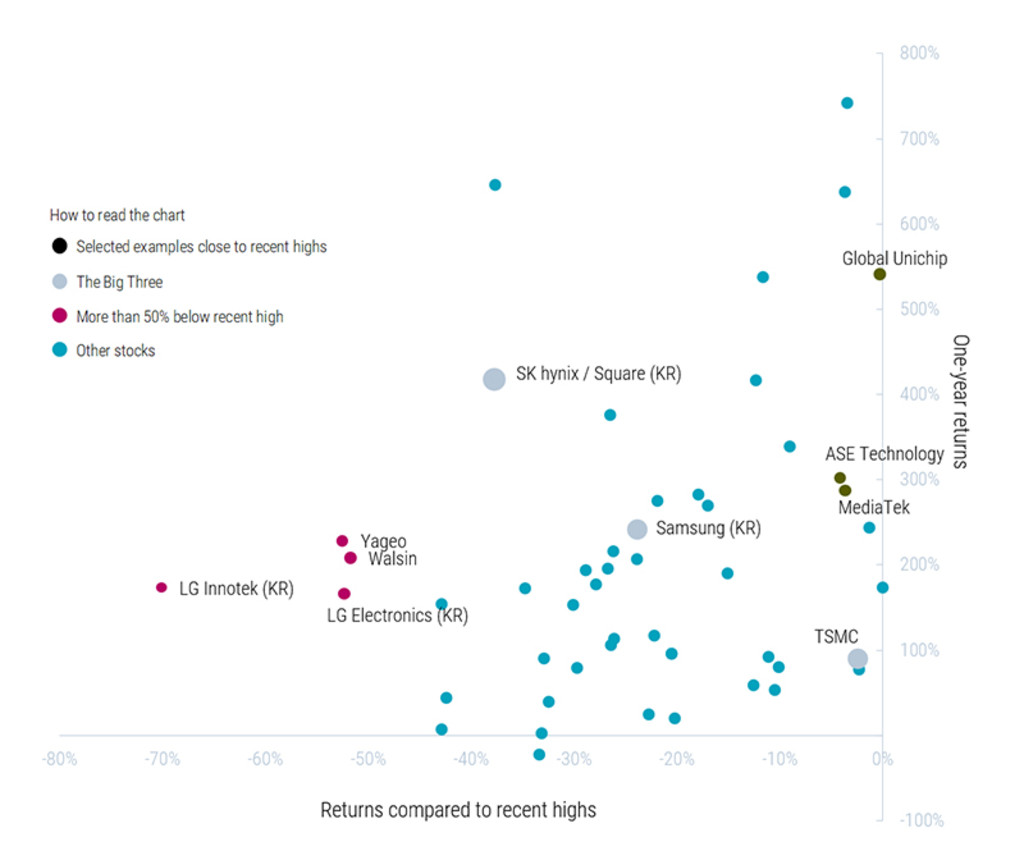
Past performance does not guarantee future results. The value of your investments will fluctuate. Companies named and shown are for illustrative purposes only. No inference can be made about their future development. This is not a buy, sell or hold recommendation. Source: Robeco analysis; Bloomberg.1 One-year share-price returns and declines from recent highs for 51 companies in the Asian AI hardware value chain. All figures as of 24 September 2026.
The scatter makes that divergence visible. MediaTek2, ASE Technology and Global Unichip, three sizable companies at the heart of the AI boom, remained within 5% of their recent highs, supported by order growth and earnings momentum. LG Innotek, LG Electronics, Yageo and Walsin were more than 50% below their peaks, despite positive one-year returns for all four.
The value chain behind the dispersion
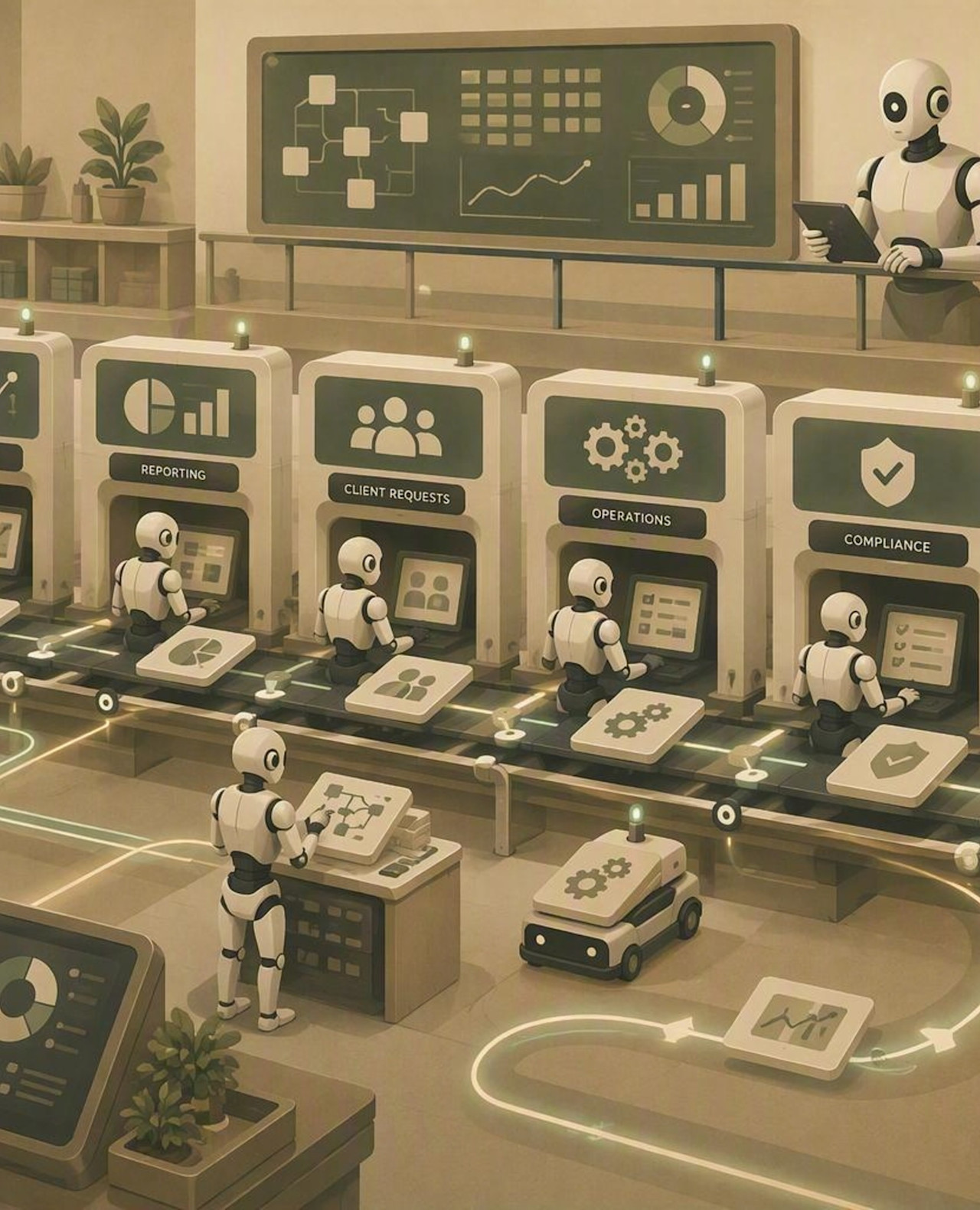
The ten-step framework in Figure 2 helps explain the spread. AI hardware moves from chip design through foundries, memory, substrates, packaging and testing, and then into networking, power and cooling, components, boards and complete servers. Companies at each stage face different demand cycles, competitive pressures and starting valuations. Exposure to the same spending boom can therefore produce very different earnings and share-price outcomes.
Figure 2 | The ten steps of the Asian AI hardware value chain
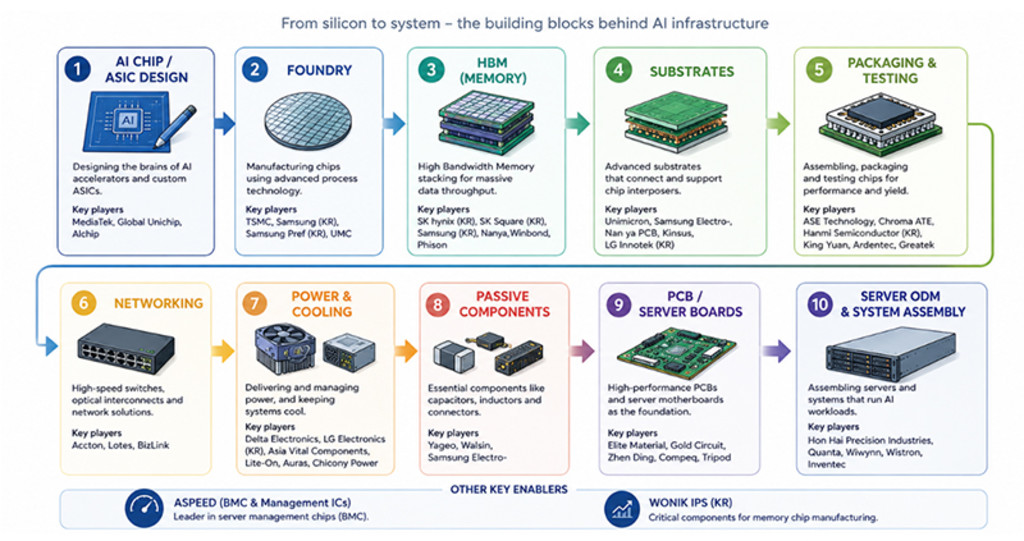
Source: Robeco. This framework is one of several possible classifications of the AI hardware value chain. It focuses on the main Taiwanese and Korean players; companies from Japan, China and the US also compete across the chain.
Why stock selection matters
For investors, identifying an AI beneficiary is only the starting point. The harder question is how much future growth the share price already reflects. A healthy AI business can still disappoint when expectations move too far ahead of earnings. Strong earnings revisions, by contrast, can support further gains after a large rally.
Robeco’s emerging markets quant strategies seek to capture these differences through many bottom-up stock-level decisions, while keeping overall country and sector exposures balanced. Indeed, so far in 2026, technology stock selection has contributed positively without an overall overweight to AI-related names.
Footnotes
1Source: The following are trademarks and service marks of Bloomberg Finance L.P., a Delaware limited partnership, or its subsidiaries: BLOOMBERG, BLOOMBERG ANYWHERE, BLOOMBERG MARKETS, BLOOMBERG NEWS, BLOOMBERG PROFESSIONAL, BLOOMBERG TERMINAL and BLOOMBERG.COM: Absence of any trademark or service mark from this list does not waive Bloomberg's intellectual property rights in that name, mark or logo. All rights reserved.
2Companies named and shown are for illustrative purposes only. No inference can be made about their future development. This is not a buy, sell or hold recommendation.