
Head of Next Gen Research


• Insight
From AI copilots to operating models in asset management
Agentic AI in asset management | Workflows
Agentic AI will change what investment professionals can do with AI, but also where AI sits in the asset management operating model.
Authors

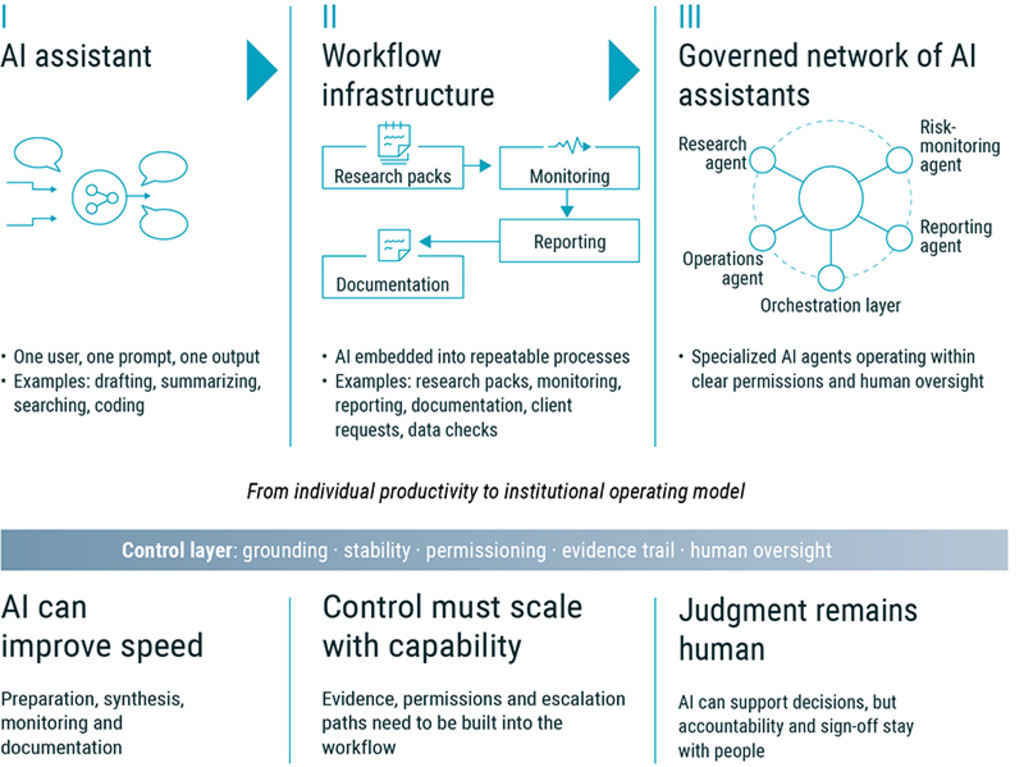
The first wave of generative AI was largely about individual productivity. AI could help a person draft, summarize, search, code or prepare a meeting note. These uses are valuable, but they usually remain task-based: one user, one prompt, one output.
Agentic AI points to a broader shift. Once AI can support a sequence of steps, use tools, preserve context and hand structured outputs to a person or another system, the relevant question changes from ‘Can this tool help me work faster?’ to ‘What workflow is this system part of, what is it allowed to do, and how is the output reviewed?’
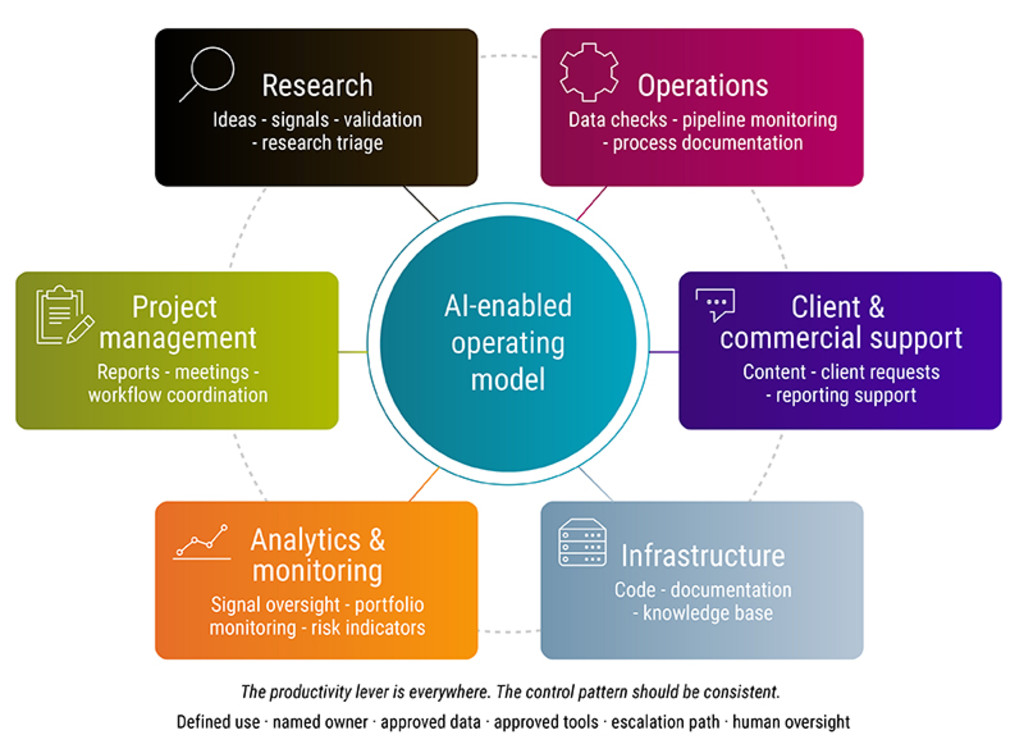
That distinction matters in asset management because investment decisions rarely happen in isolation. They sit within a wider chain of work: research preparation, portfolio monitoring, risk review, client reporting, due diligence, compliance checks, data quality, operations and documentation. AI can support many of these steps, but only if the process around it is designed deliberately.
Figure 1 | Agentic AI and workflows – when the operating model changes
Source: Robeco, August 2026.
Moving from copilot to operating model is therefore a question of capability, scale and control. A single AI assistant can be useful even if the process around it is informal. But once AI is embedded into repeatable workflows, asset managers need to think about consistency, cost visibility, operational logging, escalation paths and human sign-off.
From copilot to operating model
The infographic below shows this shift in three stages.
Figure 2 | How workflow evolves with agentic AI
Source: Robeco, August 2026.
From experimentation to investment discipline
Note that not every process should become agentic, but rather that AI-supported workflows need to earn the right to scale. That means knowing what the system is allowed to do, what data it can access, what it costs to run, how often it fails, when it retries, what evidence it uses and when it escalates to a human. It also means maintaining workflow inventories: named owners, approved data sources, approved tools, lifecycle stage, review cadence and escalation paths.
This is where the workflow discussion connects directly to governance. Grounding, stability, permissioning, evidence trails and human oversight are not separate from the operating model.1 They are what allow AI-supported workflows to move from experimentation to institutional use.
In that sense, workflow design becomes part of investment discipline. The firms that benefit most from agentic AI may not be those that automate the fastest, but those that build processes that are repeatable, reviewable, cost-aware and accountable. Indeed, rather than simply using AI more, the next step is to design better workflows around it.
Footnote
1 See Mike Chen’s ‘Agentic AI and governance’ insight

AI investing: Back to school
Agentic AI in asset management
Asset managers are moving beyond generative AI tools toward agentic AI systems that can support workflows, monitor tasks and assist with defined actions.