



Equities
Emerging economies are countries that are transitioning from low or lower middle income status towards a more advanced, industrialized, and technologically sophisticated economy, with faster growth and increasingly robust institutions.
Emerging economies generally have per capita GDP below advanced economies but above the poorest “frontier” countries, alongside functioning but less mature financial markets and regulatory systems. They often grow faster than developed economies, yet have historically exhibited higher volatility, and political or institutional risk.
Emerging markets are a subset of emerging economies that have liquid equity markets of sufficient size to be included in indices provided by major index providers like MSCI.
In the 21st century some emerging economies have transitioned to developed status with GDP per capita comparable or exceeding the levels of developed economies, boosted by significant participation in high technology industries. The most obvious examples include Taiwan and South Korea, while China is also taking a leadership position in key technology sectors like electric vehicles and renewable energy.
Common characteristics include:
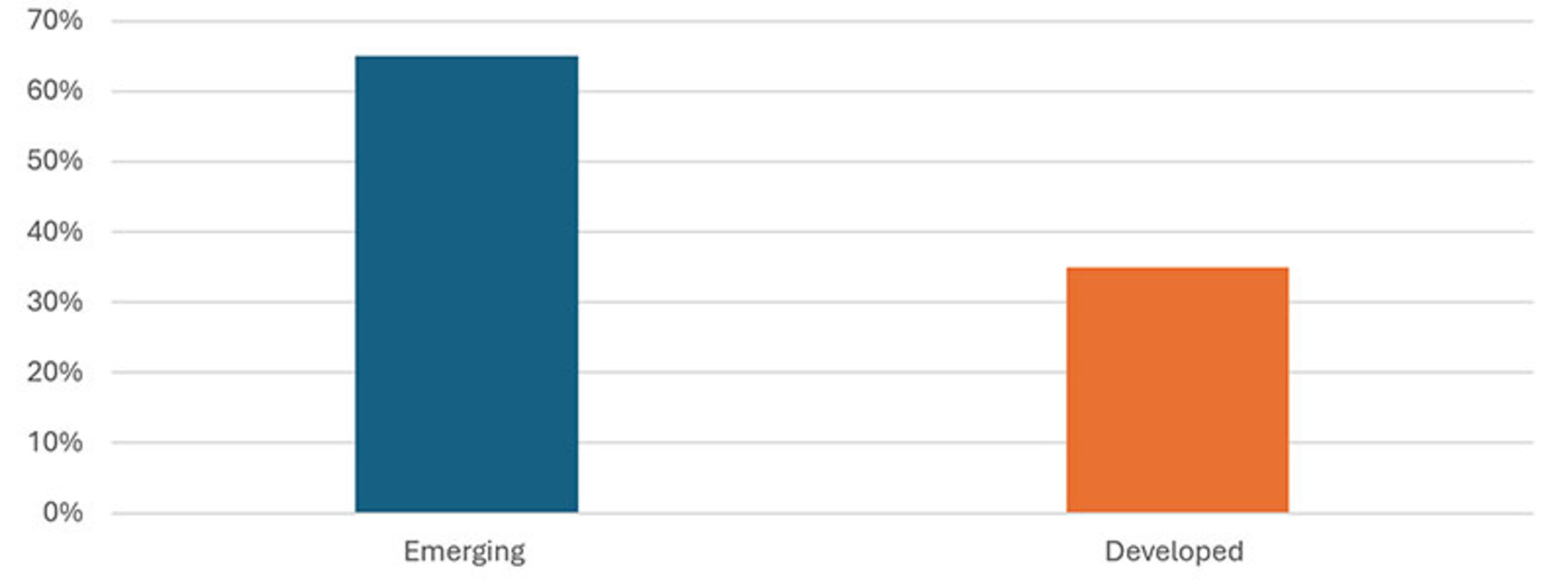
Rapid but uneven growth: Emerging economies usually post above average global GDP growth over sustained periods, driven by industrialization, urbanization, and integration into global trade and investment flows. This growth has often been cyclical and vulnerable to external shocks, unlike the slower but steadier expansion in advanced economies.
Figure 1: Percentage of incremental GDP growth projected for 2024 to 2035 – Emerging vs Developed economies
Source: S&P Global Look Forward Research Series 2024
Structural transformation: They are shifting from agriculture and simple resource extraction towards manufacturing and services, with rising productivity and export sophistication, but many emerging economies still host large informal sectors and regional disparities.
Developing institutions and markets: Emerging countries possess basic financial infrastructure—banks, stock exchanges, regulatory bodies—but these tend to be less deep, liquid, and predictable than in developed markets, with weaker rule of law, governance and enforcement. Ongoing market and regulatory reforms are a core feature.
Socio demographic dynamics: They often have large, youthful populations and rapidly growing middle classes, leading to expanding consumer markets and rising demand for infrastructure, education and services. At the same time, income inequality and social vulnerabilities remain significant.
Global integration: Emerging economies are increasingly tied into global trade, capital flows and value chains, benefiting from export growth and foreign investment but also exposed to currency swings, capital flow reversals and commodity cycles.
Representative examples usually include Brazil, China, India, South Africa, Indonesia, Mexico and others in Asia, Latin America, Eastern Europe and parts of Africa, all occupying that intermediate space between the richest advanced economies and the lowest income developing countries.
See also

Chancen in Schwellenländern entdecken
Für Anleger, die langfristige Anlagen mit echter Diversifikation anstreben, ist ein Engagement in Schwellenländern enorm wichtig.