

The EU’s Sustainable Finance Disclosure Regulation (SFDR) is getting a major update. Known as SFDR 2.0, as it follows the sweeping regulation that was first implemented in 2021, it will affect all asset managers operating within the 27-nation union, including Robeco.
The proposal for SFDR 2.0 was published by the European Commission in November 2025 and will now need to go through the full EU legislative process before coming into force. The earliest possible application date is expected to be around the beginning of 2029, but this will depend on how quickly the negotiations go.
The likely timeline is shown below. However, it should be noted that the regulatory trajectory is long, politically sensitive, and subject to intense scrutiny from within the EU. It is therefore not guaranteed that the current proposal will remain in its present form, or that it will be enacted at all.
Figure 2: SFDR 2.0 projected timeline

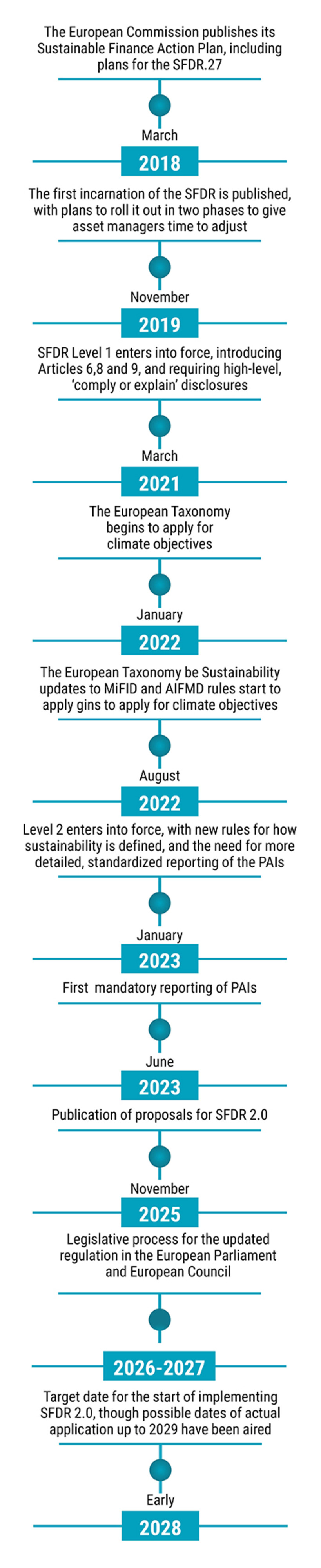
Source: EU, Robeco 2026
The introduction of labels
The SFDR classification into articles was originally meant to define transparency rules for sustainable and ESG funds. But they have de facto been (mis)used by the market as categorizations for the level of sustainability in an investment fund. SFDR 2.0 intends to remedy this.
The revised regulation introduces a new product categorization system with three labels – ‘G Basics’, ‘Sustainable’ and ‘Transition.’ The ESG Basics category will replace Article 8 requirements, and Sustainable will replace Article 9, and a new Article 7 will be introduced for the Transition bucket. Article 6 for no use of ESG stays the same. Each category comes with a set of eligibility criteria, including minimum investment commitments and mandatory exclusions.
PAIs and defining SI
Another major change is that the need to report the Principal Adverse Impact (PAI) indicators will be removed at the company level and significantly simplified at the fund level. PAIs were introduced in the original SFDR to require investors to calculate the impact that their investments in companies had on the wider world – the ‘double materiality’ principle. But they are complex and often difficult to reliably report.
SFDR 2.0 also removes the prior definition of ‘sustainable investment’, as opinion still widely differs among asset managers as to what this actually means. However, underlying concepts of what is considered a sustainable investment is maintained through the criteria applicable per label.
The new Article 7 for transition funds
The new Article 7 category will be introduced for funds which invest in companies in transition to a more sustainable business model, such as by decarbonizing or cutting their emissions. Socially-progressive transitions are also covered by the new category. Its introduction answers criticism in the original regulation that there was not a specific category for these type of funds.
Technically, Article 7 already exists, but it does not refer to fund classification. Instead, it houses the PAI criteria for application across the other Articles. Under SFDR 2.0, it becomes the new Transition bucket.
Exclusions per classification
The current SFDR doesn’t explicitly require any exclusions, although Article 8 funds can only invest in companies that follow ‘good governance’, which effectively means excluding the companies that don’t. Article 9 funds currently require 90% of the underlying investments to be sustainable, where the investee company contributes to a measurable sustainability objective (such as climate) and follows the principle that the investment ‘Does No Significant Harm’ (DNSH) to any other objective.
SFDR 2.0 tightens the rules for all investment products, as it introduces mandatory exclusions for all three ESG Basics, Transition and Sustainable buckets, the strictest of which will apply to the Article 7 Transition and Article 9 Sustainable categories.
In all, there are sweeping changes which have so far been largely welcomed by asset managers, including Robeco, as they are set to reduce complexity, cut the reporting burden, and enhance clarity and trust in sustainability related claims. But they have yet to become law.
See also:
Related insights
















More glossary terms