


Insight

Middle East conflict: Market commentary (week of March 9)

Welcome to the second part of our blog with in-depth analysis and reactions as the impact of the conflict in the Middle East continues to unfold. This is an evolving situation carrying a great deal of uncertainty as the extent and duration of the conflict is yet unknown. Our aim is to keep you informed of our views as events develop.

MONDAY, MARCH 9

  • 15:30 CET

    Multi-Asset: Winners and losers in the energy shock

    By Peter van der Welle, Multi-Asset Strategist

    The appointment of Khamenei’s son as the new Iranian leader and the prospect of a prolonged conflict delivered a major shift for oil markets. The 32% jump in oil prices so far since the Middle East turmoil erupted also exposes the fault lines in the global energy system. Oil prices typically spike as market participants demand a very large premium to insure against unexpected declines in oil spare capacity. Selmi et al. (2020* ) find that the use of spare capacity reduces the initial reaction of oil prices only moderately. The oil market wants to have more certainty that the Iranian conflict will remain limited in scope (no further attacks of Iranian proxies on refineries) and duration (weeks). However, as things stand, the market may not get what it wants even as talks about a release of strategic reserves among G10 members are underway.

    Beyond import reliance: broader measures of energy vulnerability
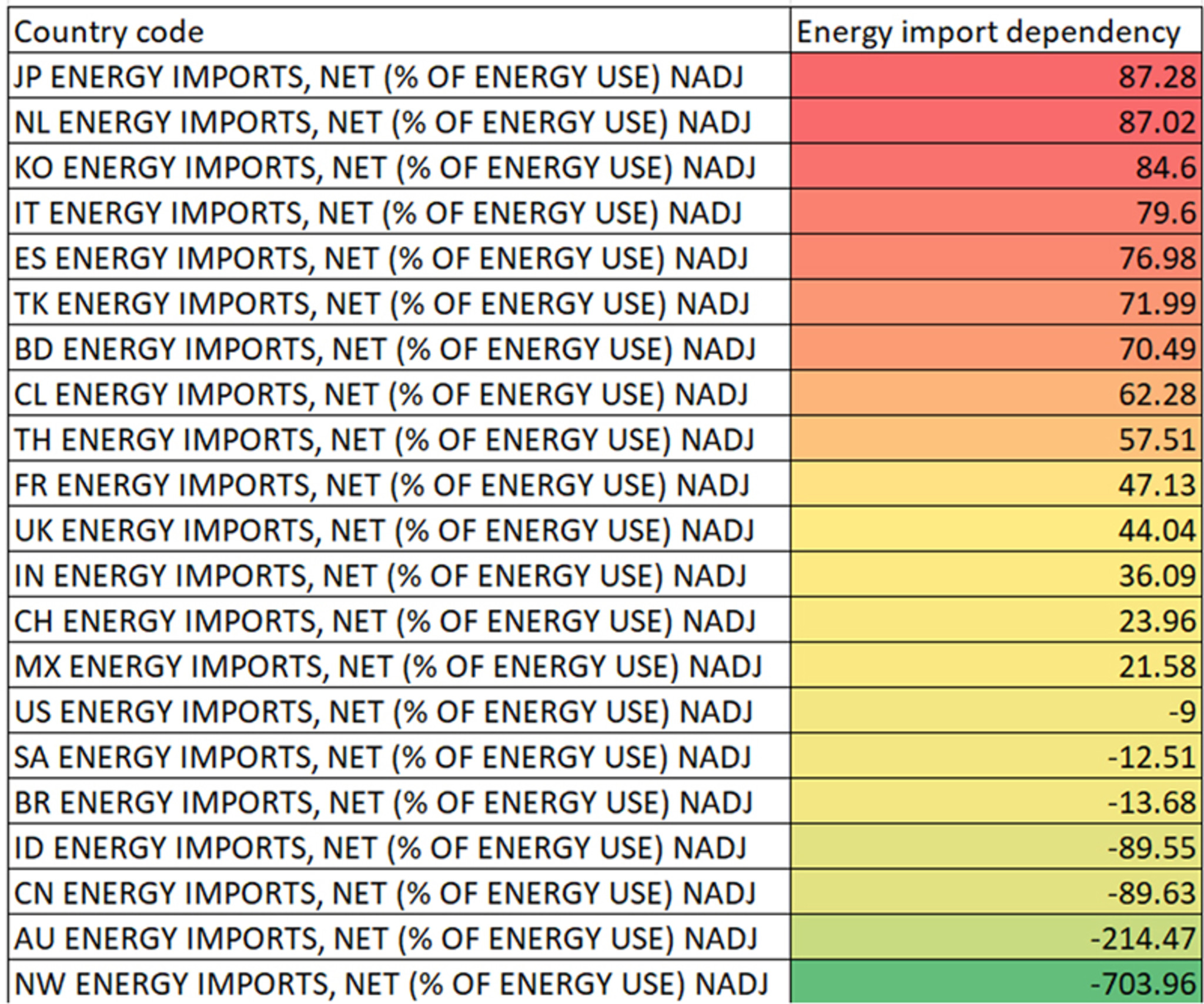
    As oil prices likely remain elevated near term, net energy exporters like the US and Norway have seen their currencies appreciate while currencies of net energy importers like Korea and the Eurozone remain under pressure. Net energy import dependency remains a useful compass to assess the fault lines. Looking at net energy imports as a percentage of domestic energy use, Japan (87%), the Netherlands (87%), Korea (85%), Italy (80%) and Spain (77%) sit at the more exposed end of the spectrum, while the US (9%), Brazil (14%), Australia (214%) and especially Norway (704%) remain structurally shielded.

    Substantial cross-country variation in energy import dependencies

    Source: LSEG Datastream, Robeco, March 2025.

    Yet, unconditional import reliance does not paint the full picture of cross-regional dispersion in energy dependency. Financial markets now also have to scrutinize the energy intensity of economies, the degree of energy import substitutability (via renewables), oil subsidy levels and the pace of inflation pass-through from energy import prices to end users to assess the implications for fiscal as well as monetary policy.

    Renewable energy: buffer or bottleneck?
    Economies with high renewable energy shares should, in theory, buffer external oil shocks. Renewable energy shares in major European economies have risen considerably in recent years (Germany now services around 25% of its energy use from renewables). Yet, renewable output only offsets fossil demand if grids can absorb and distribute it. Grid congestion and curtailment continue to inhibit substitution, forcing reliance on fossil backup when renewable generation peaks cannot be utilized. The result is a lingering vulnerability despite ambitious renewable build-out.

    Regional winners and losers in the energy shock
    Regionally, the asymmetry in relative terms of trade is clear. Asia is most directly at risk, as at the time of writing the Strait of Hormuz remains virtually closed and 83% of oil transiting the Strait of Hormuz is flowing toward Asian buyers. Europe comes next, constrained by limited substitutability and swift pass-through rates to end users. Australia, Norway and the US remain relative winners, supported by domestic production, low energy intensity (the US manufacturing share of GDP has steadily declined in recent decades), and the potential for shale drillers’ responsiveness if higher prices persist.

    *Selmi, R., Bouoiyour, J., & Miftah, A. (2020). Oil price jumps and the uncertainty of oil supplies in a geopolitical perspective: The role of OPEC’s spare capacity. International Economics, 164, 18–35. https://doi.org/10.1016/j.inteco.2020.06.004

Middle East conflict: Market commentary

Key contributors

  • Client Portfolio Manager
  • Portfolio Manager
  • Client Portfolio Manager

    Meena Santhosh

  • Head of Quant Client Portfolio Management
  • Strategist, Investment Solutions
  • Client Portfolio Manager
  • Head of Asia-Pacific Equities
  • Head of Multi Asset & Equity Solutions, Co-Head Investment Solutions
  • Strategist
  • Portfolio Manager and Co-Head of Robeco’s Global Equity team
  • Client Portfolio Manager

Let's keep the conversation going

Keep track of fast-moving events in sustainable and quantitative investing, trends and credits with our newsletters.

Don’t miss out

Robeco aims to enable its clients to achieve their financial and sustainability goals by providing superior investment returns and solutions.

Important information
The Robeco Capital Growth Funds have not been registered under the United States Investment Company Act of 1940, as amended, nor or the United States Securities Act of 1933, as amended. None of the shares may be offered or sold, directly or indirectly in the United States or to any U.S. Person (within the meaning of Regulation S promulgated under the Securities Act of 1933, as amended (the “Securities Act”)). Furthermore, Robeco Institutional Asset Management B.V. (Robeco) does not provide investment advisory services, or hold itself out as providing investment advisory services, in the United States or to any U.S. Person (within the meaning of Regulation S promulgated under the Securities Act).
This website is intended for use only by non-U.S. Persons outside of the United States (within the meaning of Regulation S promulgated under the Securities Act who are professional investors, or professional fiduciaries representing such non-U.S. Person investors. By clicking “I Agree” on our website disclaimer and accessing the information on this website, including any subdomain thereof, you are certifying and agreeing to the following: (i) you have read, understood and agree to this disclaimer, (ii) you have informed yourself of any applicable legal restrictions and represent that by accessing the information contained on this website, you are not in violation of, and will not be causing Robeco or any of its affiliated entities or issuers to violate, any applicable laws and, as a result, you are legally authorized to access such information on behalf of yourself and any underlying investment advisory client, (iii) you understand and acknowledge that certain information presented herein relates to securities that have not been registered under the Securities Act, and may be offered or sold only outside the United States and only to, or for the account or benefit of, non-U.S. Persons (within the meaning of Regulation S under the Securities Act), (iv) you are, or are a discretionary investment adviser representing, a non-U.S. Person (within the meaning of Regulation S under the Securities Act) located outside of the United States and (v) you are, or are a discretionary investment adviser representing, a professional non-retail investor.


Access to this website has been limited so that it shall not constitute directed selling efforts (as defined in Regulation S under the Securities Act) in the United States and so that it shall not be deemed to constitute Robeco holding itself out generally to the public in the U.S. as an investment adviser. Nothing contained herein constitutes an offer to sell securities or solicitation of an offer to purchase any securities in any jurisdiction. We reserve the right to deny access to any visitor, including, but not limited to, those visitors with IP addresses residing in the United States. This website has been carefully prepared by Robeco. The information contained in this publication is based upon sources of information believed to be reliable. Robeco is not answerable for the accuracy or completeness of the facts, opinions, expectations and results referred to therein. Whilst every care has been taken in the preparation of this website, we do not accept any responsibility for damage of any kind resulting from incorrect or incomplete information. This website is subject to change without notice. The value of the investments may fluctuate. Past performance is no guarantee of future results. If the currency in which the past performance is displayed differs from the currency of the country in which you reside, then you should be aware that due to exchange rate fluctuations the performance shown may increase or decrease if converted into your local currency. For investment professional use only. Not for use by the general public.